Chips & Hardware
Venus Aerospace raises $90M Series B for its rocket engine
Venus Aerospace raised a $90 million Series B to fund testing of its Rotating Detonation Rocket Engine (RDRE) for defense and space customers.
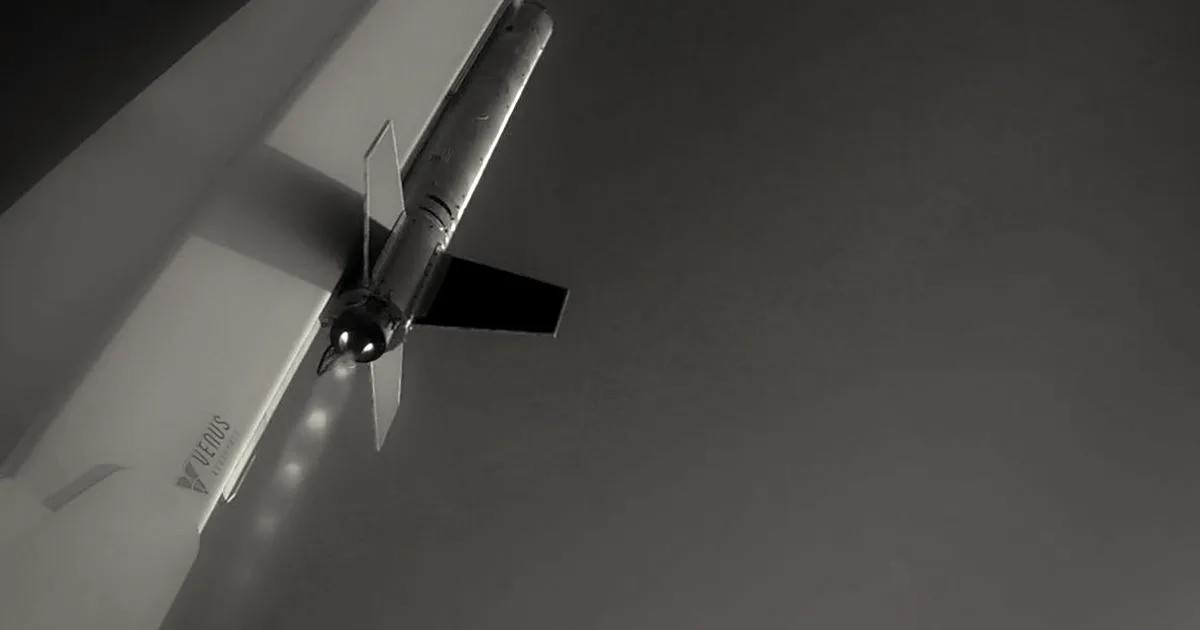
Venus Aerospace has raised a $90 million Series B round led by Mercury Fund, with participation from Lockheed Martin Ventures, MESH, PEAK6, Draper Associates, Starboard Star Venture Capital, and Green Sands Equity. The company plans to use the funding to test and develop specific vehicle designs with potential customers.
Venus was founded in 2020 by husband-and-wife duo CEO Sassie Duggleby and CTO Andrew Duggleby, originally to build clean-flying hypersonic jets for passenger travel. Those plans changed after the company successfully demonstrated its RDRE in flight last May. “What happened when we flew last May is the world looked at us and said, ‘oh my gosh, you have a working RDRE, would you sell us one?’ And that wasn’t what we were expecting,” Sassie Duggleby told TechCrunch. Venus is now focused on hypersonic weapons development — replacing the solid rocket motors used in many missiles with its own thruster — and on high-speed space vehicles for military customers. Andrew Duggleby said in a statement that the company’s propulsion architecture combines efficiency, throttling, reusability, and manufacturability in a way that meets the needs of real defense and space missions, and that Venus is focused on translating its technical progress into reliable operational systems.
The RDRE was first conceived decades ago as a theoretically more efficient way to launch rockets: instead of burning propellant in a round chamber, it creates a continual supersonic wave of combustion that rotates through a circular channel, wasting less propellant. The physics proved difficult to control until the advent of 3D printing and better simulations in recent years. The first working RDRE test took place in 2020 at the University of Central Florida; NASA demonstrated one on the ground in 2022; and Japan’s space agency, JAXA, fired one in space for a few seconds in 2021. Venus’s 2025 test marked the first time an RDRE launched a rocket into flight.
Much of the company’s four years of work has focused on keeping the engine from melting, a problem Sassie Duggleby said Venus has now solved. This year, the company was awarded a grant from the Texas Space Commission to build a new, larger test stand — a step it needs because the longest it has fired the engine across 600 tests is 32 seconds, while customer goals will likely require burns of at least six to 15 minutes.
Why it matters
Venus’s pivot from passenger jets to defense and space hardware shows hypersonic propulsion finding faster commercial traction through military customers than through civilian aviation. Whether the RDRE becomes a fielded technology hinges on extending burn times from 32 seconds toward the six-to-15-minute range its customers need.