Apps & Consumer
Tinder pivots to IRL events and AI in product overhaul
Tinder held its inaugural product keynote, introducing AI-driven matching and IRL event features to re-engage younger users amid declining subscriber growth.
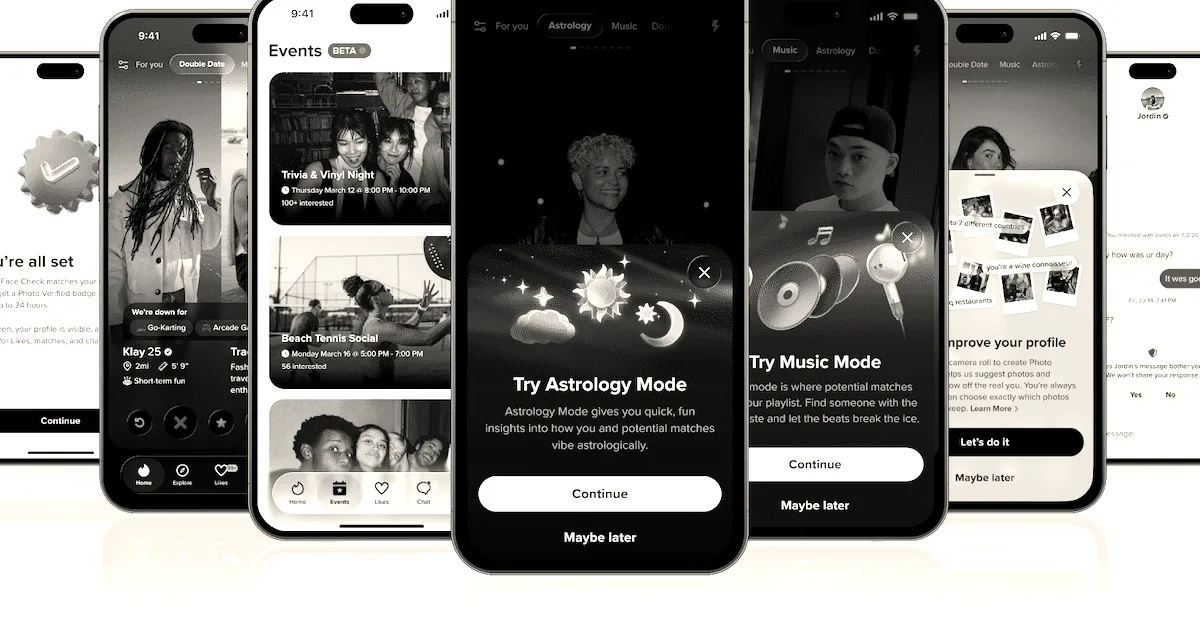
Tinder held its inaugural product keynote on Thursday, marking a strategic shift to move beyond its traditional swiping model. The dating app is introducing artificial intelligence features and real-world event discovery to re-engage its user base. This product overhaul follows a $60 million investment in product development by parent company Match Group, which was announced last August. The investment comes as Match Group seeks to reverse consecutive quarters of declining paying subscribers.
To capture younger users, Tinder is focusing on in-real-life (IRL) experiences and virtual speed dating. Hillary Paine, senior vice president of product at Tinder, explained that the company is trying to blend dating and social lives. “Instead of asking users to choose between their dating life and their social life, we’re trying to blend these things together and create a more social community first experience,” Paine said.
The company is introducing several new features to support this strategy:
- Events tab: A new feature, launching in beta for users in Los Angeles in late May or early June, that allows users to discover curated local events to connect with matches in person.
- Video speed dating: A pilot program in Los Angeles featuring scheduled three-minute video chats, allowing users to check compatibility before meeting in person.
- Chemistry: An AI feature that learns about users through questions and their camera rolls to curate daily matches. It is rolling out in the U.S. and Canada after initial testing in Australia and New Zealand.
- Learning Mode: An AI system designed to quickly gain insights into what users seek, adapting recommendations from their very first session.
- Music Mode: A feature allowing users to add up to 20 Spotify songs to their profiles.
Alongside these features, Tinder is updating its safety tools. The app’s “Does This Bother You?” feature will use large language models to better detect ‘harmful messages’ and automatically blur ‘disrespectful content’. Additionally, the “Are You Sure?” prompts are being refined to more accurately identify ‘potentially harmful interactions’. These updates arrive as Match Group reported $878 million in revenue for Q4 2025, even as it faces ongoing pressure to retain users and restore investor confidence amid changing user preferences and competition from apps like Breeze, 222, Timeleft, and Thursday.
Why it matters
Tinder is attempting to re-engage its user base and win over younger Gen Z daters by shifting away from solely relying on swiping and adapting to what it believes its young users want, following consecutive quarters of declining paying subscribers.