AI & Models
Stanford report finds growing divide between AI experts and public
Stanford’s annual AI report reveals a widening gap between expert optimism and public anxiety regarding AI’s impact on jobs, the economy, and medical care.
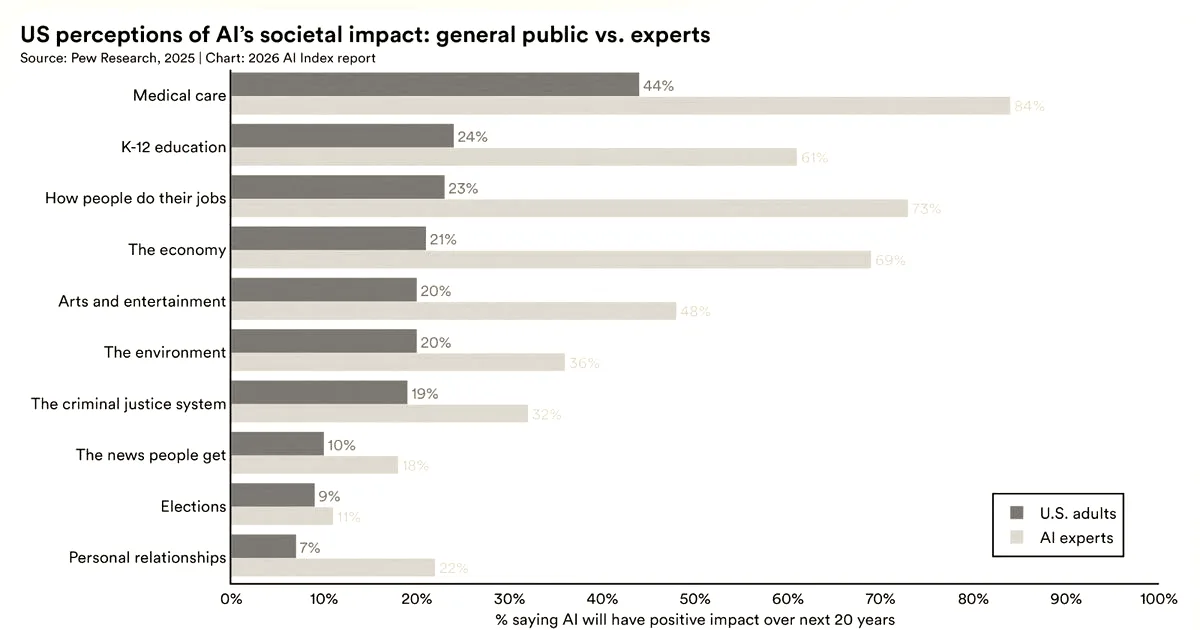
On Monday, Stanford University released its annual report on the AI industry, highlighting an increasing divergence between the opinions of AI experts and the general public. The study notes a growing trend of anxiety around AI and concerns regarding its impact on key societal areas. Globally, the share of people who feel that AI products and services offer more benefits than drawbacks rose from 55% in 2024 to 59% in 2025. However, during the same period, the proportion of respondents who said AI makes them nervous also grew from 50% to 52%. In the U.S., a Pew Research study cited in the report found that only 10% of Americans said they were more excited than concerned about the increased use of AI in daily life, with a Gallup poll indicating that Gen Z is reportedly leading the way in negative sentiment.
This divergence is particularly sharp when comparing the long-term outlook of industry insiders against public expectations. While 56% of AI experts believe AI will have a positive impact on the U.S. over the next 20 years, the general public remains highly skeptical. For instance, 84% of experts state that AI will have a largely positive impact on medical care over the next 20 years, but only 44% of the U.S. public agrees. Similarly, 73% of experts feel positive about AI’s impact on how people do their jobs, compared to just 23% of the public. On the economy, 69% of experts expect a positive impact, while only 21% of the public shares this view. This economic anxiety is closely tied to employment concerns: nearly 64% of Americans believe AI will lead to fewer jobs over the next 20 years.
Public trust in government oversight also varies widely by region. According to Ipsos data cited in the report, only 31% of respondents in the U.S. trust their government to regulate AI responsibly, compared to 81% in Singapore. Regarding domestic policy, U.S. public opinion on the adequacy of federal oversight is split: 41% of respondents believe federal AI regulation will not go far enough, while 27% argue it will go too far.
This widening disconnect comes as industry leaders focus heavily on managing the development of Artificial General Intelligence (AGI)—defined as a theoretical form of AI superintelligence that can think for itself and perform any task a human can. Meanwhile, everyday concerns about wages and job security have fueled a broader public backlash. This friction has manifested in extreme real-world incidents, including the attacks on OpenAI CEO Sam Altman’s home, the shooting of the United Healthcare CEO in 2024, and the burning of a Kimberly-Clark warehouse.
Why it matters
The report highlights a growing disconnect between AI experts and the general public regarding the technology’s societal impact, particularly concerning jobs, the economy, and medical care, which helps explain the rising anxiety and negative sentiment surrounding AI.