Apps & Consumer
Viral app Roost slows messaging to the speed of a carrier pigeon
Roost, a "slow-cial" app where messages travel at real bird speeds, is about to hit 300,000 users about five weeks after a viral Threads post.
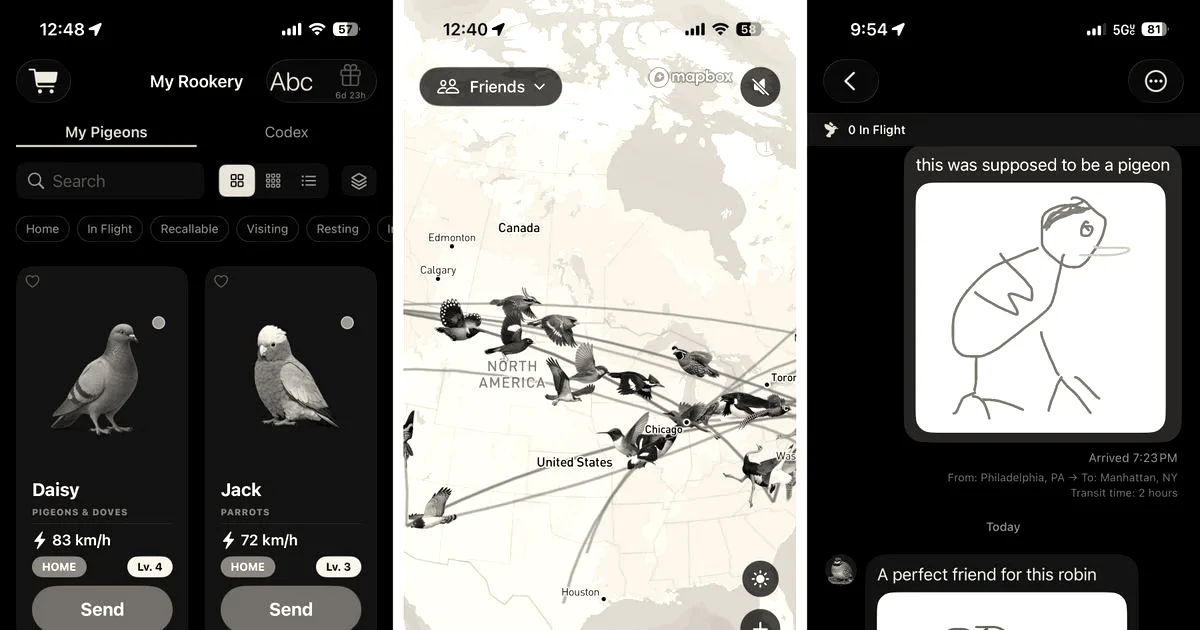
Roost lets users send messages that arrive only as fast as a virtual bird can fly — hours or even days, depending on the distance and the species chosen. Each of the four birds a user picks for their “rookery” moves at its real-world speed, so a falcon delivers faster than a hummingbird; users who want even more delay can send a snail or a turtle instead. “Everything on a phone is instantaneous these days — every single thing you do, it’s like you’re always getting some notification or something,” creator Logan Mendelsohn told TechCrunch. “[Roost] is kind of a break from the instant.”
Mendelsohn, a senior product manager in trust and safety at Ticketmaster, built Roost as a side project for himself and his friends before they convinced him to publish it to the App Store. It found a small niche following, then grew exponentially after a mother posted on Threads that her daughter was writing to friends in Elizabethan English on an app that delivers messages at the speed of actual birds. Within three days of that post, Roost grew from 10,000 to 100,000 users; about five weeks later, it is about to hit 300,000.
Privacy is built into the app’s defaults: only a user’s city, not precise location, is shared with friends by default, and a “close friends” feature that shares exact location must be turned on manually. The “Pen Pals” feature, which lets users exchange messages with anonymous users in their age group, explicitly warns people during onboarding not to share contact information or personal details. Roost also does not yet support photo sharing, which Mendelsohn attributes to wanting more sophisticated content-moderation tools first.
Mendelsohn has used Claude Code throughout Roost’s development, but many of the users drawn to the app’s slower pace also turned out to be fatigued with the state of the tech industry, and he received a wave of complaints once people learned the app’s bird art was AI-generated. “On the AI art side, I completely understood the feedback… I don’t think it’s productive to dig your heels in when your community is vocal about something they care for,” he said, adding that replacing the art in an app this size “takes time, planning, and money.” He is now running a contest for artists to contribute art instead. Mendelsohn has no outside funding, and Roost’s only revenue comes from in-app purchases like extra birds. “As a solo founder, I don’t think I could build and maintain something at this scale without AI-assisted development, but every product decision and direction for Roost still comes from me and the community,” he said.
Why it matters
Roost’s growth shows a market appetite for deliberately slower, friction-adding apps as a counterweight to constant notifications — but its AI-art backlash shows that same audience won’t extend the same patience to AI-generated content, forcing even an AI-built app to walk some of that tooling back.