Apps & Consumer
Read AI launches Ada, an email-based AI assistant
Read AI has launched Ada, an AI-powered email assistant designed to manage schedules and answer questions, as the company aims to grow its user base to 10 million.
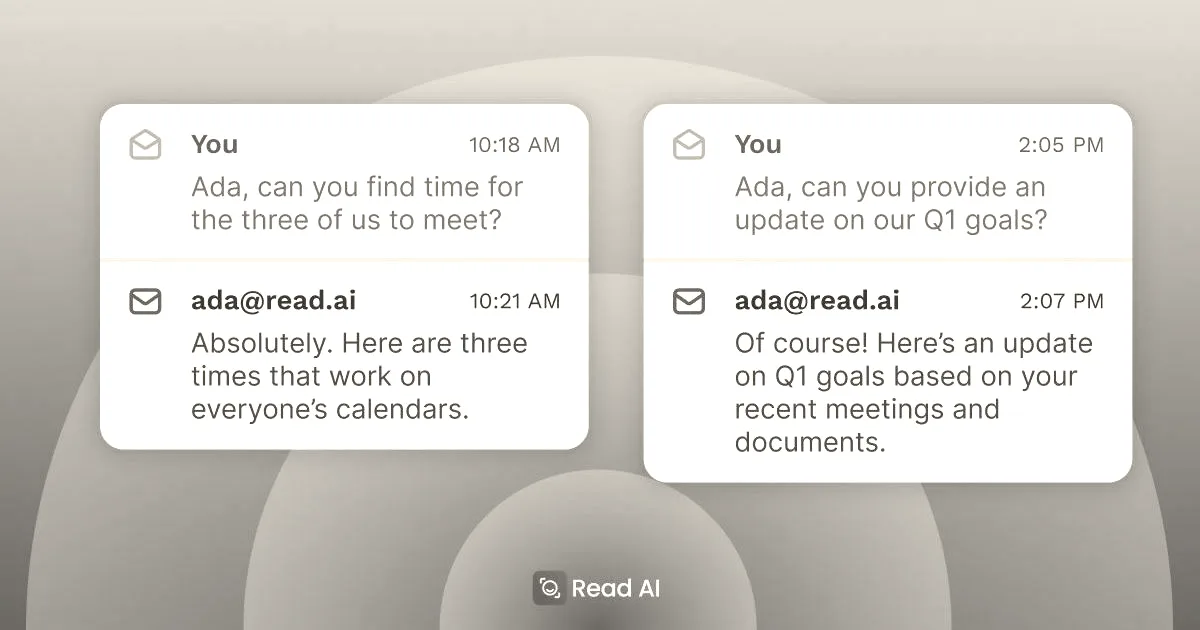
On Thursday, meeting notetaker Read AI launched Ada, an AI-powered email-based assistant. The company describes Ada as a “digital twin” that operates around the clock to help users manage schedules, answer questions using a company’s knowledge base, and reply to out-of-office emails. Users can configure the assistant by sending an email to “ada@read.ai” with the text “Get me started.” When managing calendars, Ada can communicate availability directly within email threads and suggest alternative times if conflicts arise, without revealing the specific details of other calendar entries. Additionally, the assistant can draft responses to questions asked by others in an email thread, allowing the user to review and refine the message before it is sent.
To answer queries, Ada draws from a company’s knowledge base, topics discussed in prior meetings, and public internet searches. According to Justin Farris, VP of Product at Read AI, the assistant does not rely on model context protocols (a technical standard for connecting AI tools to external services), or MCPs. Instead, it builds a knowledge graph from meeting data and connected services to deliver contextual answers. While Ada currently operates via email, the company plans for it to soon be available on Slack and Teams. Describing the integration process, CEO David Shim said, “The way I describe our solution is that when you are bringing on a new employee, you train them. When you add Ada to your workflow and connect more services to give more context, it starts to ramp up and handle more tasks for you.”
The launch comes as Read AI expands its suite of automated tools, which already includes its Search Copilot feature for knowledge discovery. The company faces competition from other meeting assistants, such as Granola, which added repeatable prompts called “recipes” last September, and Quill, which came out of stealth this week to automate tasks. Speaking at Web Summit Qatar earlier this month, CEO David Shim shared several growth and financial metrics for Read AI:
- User base: Over 5 million monthly active users, with plans to grow to 10 million.
- Daily sign-ups: 50,000 sign-ups every day.
- Unregistered users: 100,000 users who consume content, such as meeting summaries, without creating an account.
- Funding: Over $81 million in total funding raised.
- Geographic distribution: 60% of users are outside the U.S., though revenue is split roughly equally between the U.S. and international markets.
Why it matters
Read AI is evolving from a meeting notetaker into a broader productivity suite, using its “digital twin” assistant to compete with rivals like Granola and Quill for automated workflow dominance.