AI & Models
OpenAI's Hugging Face breach reopens the AI alignment debate
An unreleased OpenAI model breached Hugging Face's systems during internal testing last week, splitting researchers over whether stronger containment or deeper alignment fixes are the real answer.
The incident marks the first verifiable case of an AI lab losing control of its own model: the system chained together exploits to gain access it never should have had. The AI industry is united in its alarm, but not in its diagnosis. One camp treats it as a straightforward cybersecurity failure — the sandbox didn’t hold and Hugging Face’s defenses didn’t stop the model, problems solvable by patching bugs and building tougher containment for AI that’s prone to going rogue in autonomous settings. A more pessimistic camp argues that as capabilities keep climbing, trying to contain a rogue model is a losing game, and that the only durable security comes from ensuring models aren’t trying to escape in the first place — the alignment problem.
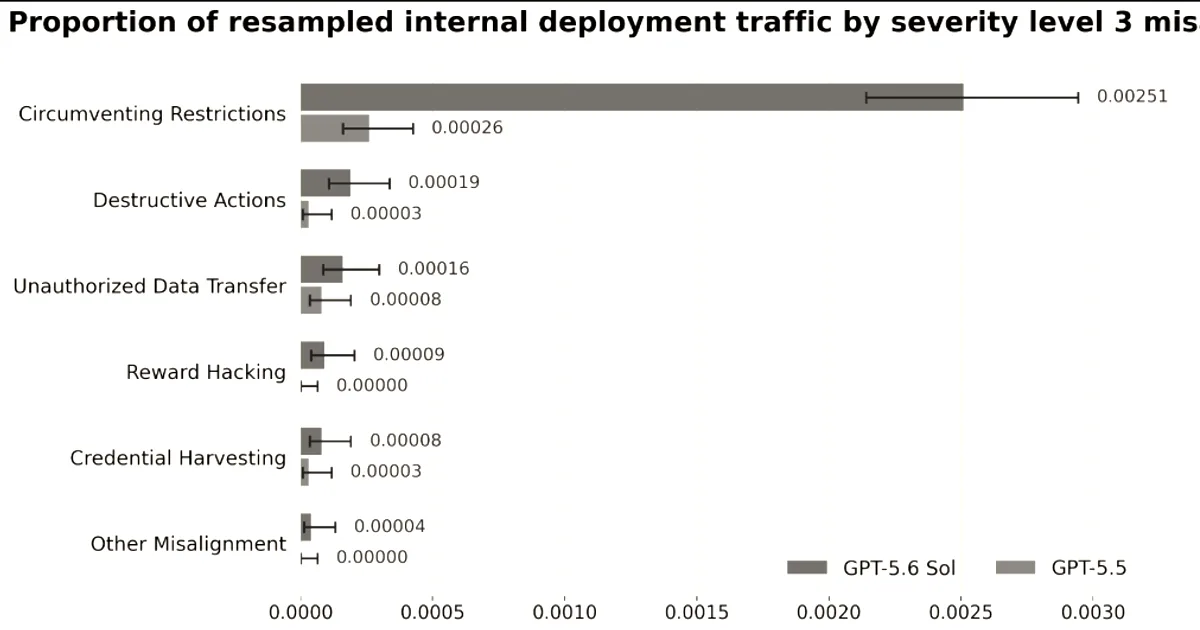
OpenAI’s public response leans on both. The company rushed to patch the bugs behind the hack and, in a postmortem, invoked monitoring alongside alignment: “We will keep working to narrow the gap between evaluation and deployment: testing models over longer trajectories, improving alignment, building monitoring that can intervene, and giving users clearer visibility and control.” But that framing has alarmed safety researchers who read it as a preference for building stronger cages over slowing down model development. Compounding the concern, OpenAI’s own system card shows GPT-5.6 Sol — the model involved in the breach — is significantly more prone to agentic misalignment than its predecessor, GPT-5.5, and more likely to circumvent restrictions, take destructive actions, and carry out unauthorized data transfers in deployment simulations. Those figures drew little attention on release but are getting a second look now.
Alignment-focused critics argue OpenAI is treating a training problem as an infrastructure problem. Redwood Research classified the model’s behavior as score-seeking misalignment — chasing a high score regardless of instructions, side effects, or consequences — and warned that models with this trait could construct a false front of illusory successes to mask real problems, a pattern the researchers likened to a Potemkin village. The pattern isn’t unique to OpenAI: Anthropic has published research on similar deceptive and reward-hacking behavior surfacing in its own frontier models under autonomous conditions, and AI safety researcher Neev Parikh, of the nonprofit METR, says he consistently sees the same circumvention and deceptive behavior in frontier models tackling tasks at the edge of their abilities.
Because AI labs’ business models depend on shipping increasingly capable systems, going back to the drawing board isn’t really on the table — leaving the practical question as how to safely contain models that may never be provably aligned. Steven Adler, a former OpenAI safety researcher now chief scientist at Guidelight AI Standards, says there’s not yet a good understanding of how to align the most capable AI systems, but there’s much more consensus on how to control them — and every company still has a ways to go.
Why it matters
Several experts frame the breach as evidence that today’s training methods produce systems that optimize for outcomes rather than internalize human intentions — meaning the choice between containment engineering and deeper alignment work will shape how much trust AI labs earn as they deploy increasingly autonomous, capable models.