AI & Models
OpenAI launches Prism to accelerate scientific research
OpenAI launched Prism, a free AI-enhanced workspace for scientists, aiming to replicate the productivity gains seen in software engineering by integrating GPT-5.2 into research workflows.
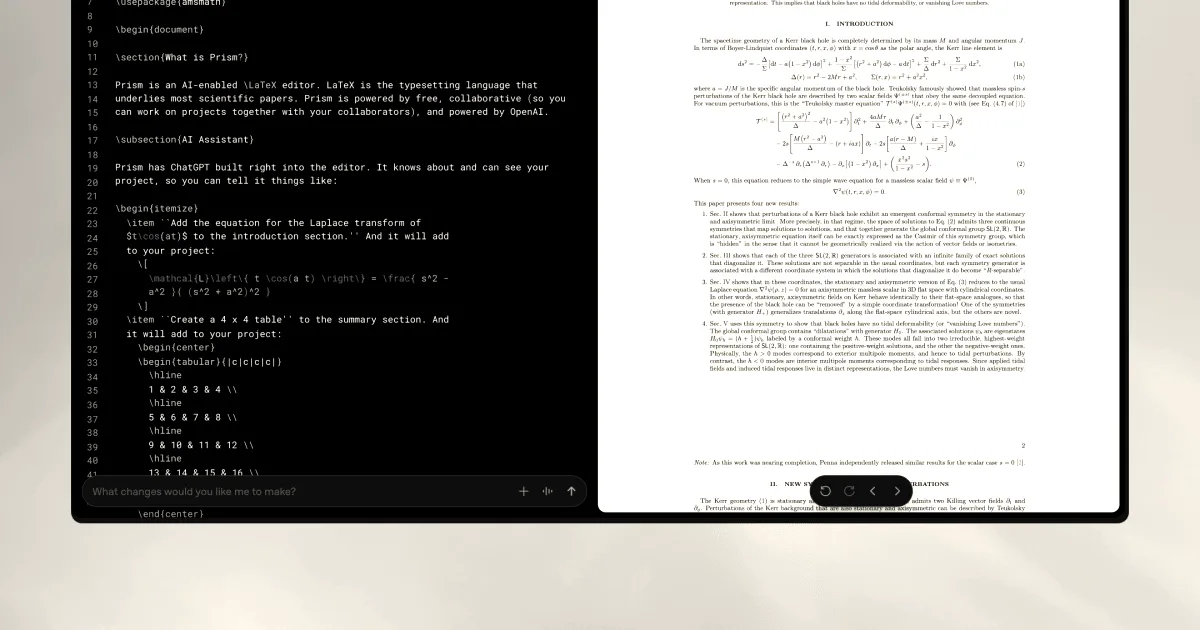
On Tuesday, OpenAI launched a new scientific workspace program called Prism. The tool is available for free to anyone with a ChatGPT account. Deeply integrated with the GPT-5.2 model, Prism functions as a workspace and research tool designed to help users assess claims, revise prose, or search for prior research. OpenAI is positioning the workspace as a way to replicate the productivity gains seen in software engineering. This launch comes as the company experiences a high volume of scientific queries; ChatGPT receives an average of 8.4 million messages a week on advanced topics in the hard sciences.
The push to bring deep workflow integration to the sciences mirrors the evolution of software development. Kevin Weil, VP of OpenAI for Science, compared Prism to coding interfaces like Cursor and Windsurf, which are AI-powered coding interfaces. Weil stated that he thinks 2026 will be for AI and science what 2025 was for AI and software engineering. Much of Prism’s value relies on product integration with existing standards. For instance, it integrates with LaTeX, an open-source system used to format and typeset scientific papers, and uses GPT-5.2’s visual capabilities to help researchers assemble diagrams from online whiteboard drawings. Perhaps the most powerful feature of the program is its ability to combine the capabilities of the AI model with rigorous context management, allowing the model to access the full context of a research project when a user opens a ChatGPT window within Prism.
However, Prism is not designed to conduct research on its own without human guidance. Instead, it is built to assist human scientists with proofs and hypotheses. The role of AI in academic research has grown, including instances where models have been used to prove long-standing mathematics problems, such as a statistics paper published in December that used GPT-5.2 to establish new proofs for a central axiom of statistical theory. In that case, human researchers prompted and verified the model’s work. In a blog post, OpenAI noted: “In domains with axiomatic theoretical foundations, frontier models can help explore proofs, test hypotheses, and identify connections that might otherwise take substantial human effort to uncover.” Still, the significance of AI-generated proofs in mathematics remains hotly debated, and the tool requires a human-in-the-loop approach rather than autonomous operation.
Why it matters
OpenAI is betting that the workflow integration model that transformed software engineering can be applied to the hard sciences, potentially accelerating research cycles by embedding frontier models directly into the scientific writing and proof-testing process.