AI & Models
SpaceX and xAI shift focus from Mars to lunar AI infrastructure
Elon Musk is pivoting xAI’s recruitment and corporate narrative toward building AI data centers on the Moon, shifting focus away from previous Mars colonization goals.
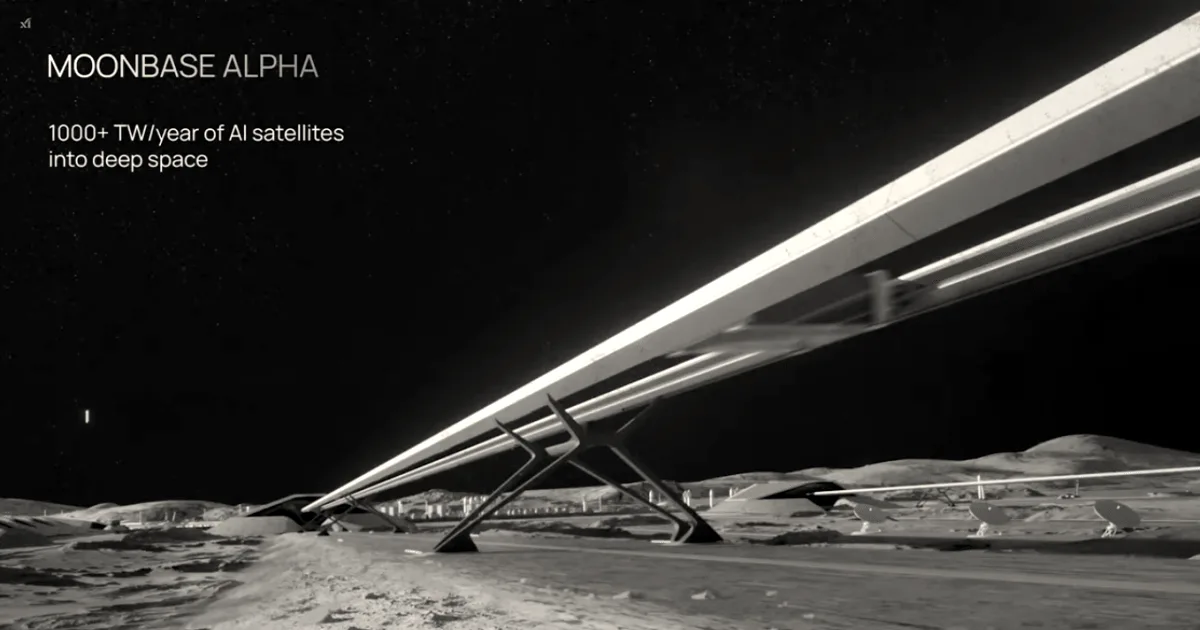
Elon Musk is recruiting for his artificial intelligence venture, xAI, by promoting a vision of building mass drivers on the Moon. A mass driver is a proposed method of non-rocket spacelaunch using electromagnetic acceleration, which Musk plans to use to launch AI satellites into deep space. In a recent recruitment push, Musk stated, “Join xAI if the idea of mass drivers on the Moon appeals to you,” signaling a strategic shift in the long-term goals of both xAI and his rocket manufacturer, SpaceX. This new direction includes plans to build AI data centers in orbit and on the Moon, establishing a physical infrastructure link between the two companies.
This pivot follows SpaceX’s decision to back away from its goal of colonizing Mars, which previously aimed to establish one million people living on Mars. The restructuring of these companies, which comes amid an anticipated IPO, replaces the Martian narrative with a focus on climbing the Kardashev Scale. Coined in the 1960s, the Kardashev Scale is a theoretical measure of a civilization’s level of technological advancement based on its energy usage. Musk has questioned how to expand power capacity beyond a single terawatt per year, suggesting that a lunar base could harness a few percent of the sun’s energy to run AI models. He noted that it is difficult to imagine what an intelligence of that scale would think about.
While experts report that it might be possible to build data centers in Earth orbit in the 2030s, the broader lunar plan faces significant technical hurdles. The shift contrasts with SpaceX’s current focus, which has scaled back its deep-space ambitions to prioritize launching satellites and fulfilling $4 billion in contracts to land astronauts on the moon for NASA. This is a departure from 2016 plans to repurpose Dragon spacecraft for Mars. The grand lunar vision also serves to address the reputation of xAI, whose large language model has been characterized as a “pervert.” A departing executive recently complained that other AI labs are all building the same boring products. While the moon base idea has been characterized as “insane,” it provides a highly visible alternative to the standard industry path.
Why it matters
Elon Musk is shifting the corporate narrative for xAI and SpaceX away from Mars colonization toward AI-focused space infrastructure, using this vision as a recruitment tool and a strategy to align with a potential IPO.