Apps & Consumer
Jack Dorsey launches Buzz, an AI-agent rival to Slack and GitHub
Block co-founder Jack Dorsey unveiled Buzz, an open-source group chat platform that lets humans and AI agents work in the same conversations, positioning it against Slack and GitHub.
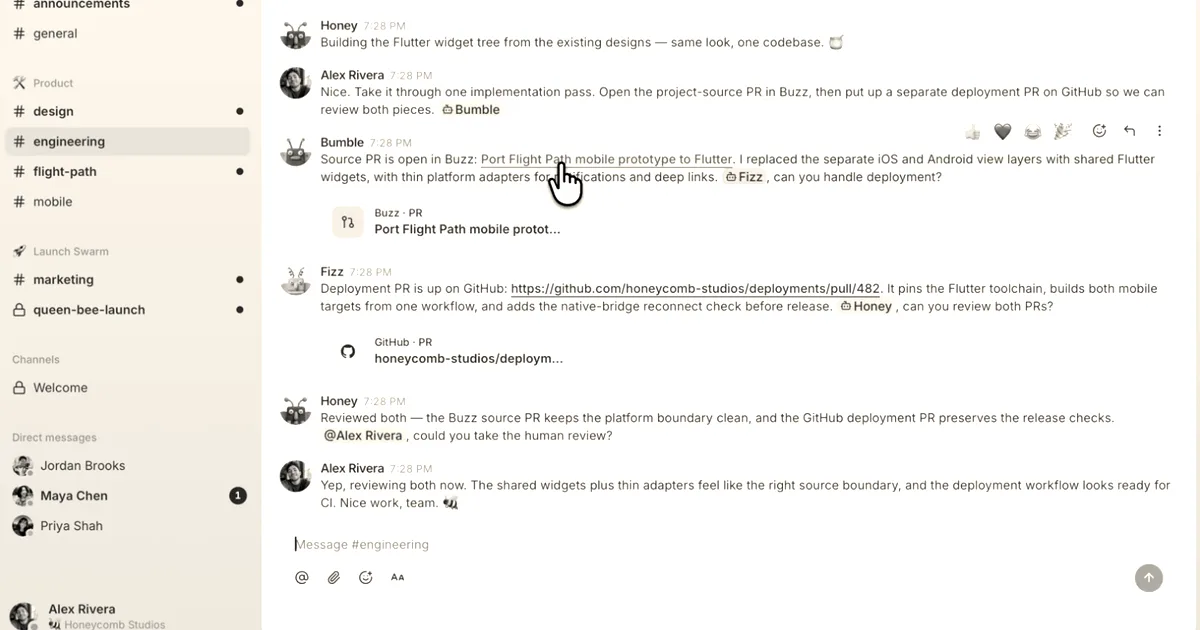
Twitter and Block co-founder Jack Dorsey introduced a new workplace app called Buzz on Tuesday, positioning it as a direct challenger to Slack and GitHub. Buzz is a group chat platform built to put humans and their AI agents into the same conversations, rather than treating agent work as a separate workflow bolted onto existing tools.
Dorsey described Buzz on X as model-agnostic, decentralized, self-sovereign, and open source. According to its website, Buzz was built by Block, the company Dorsey also runs alongside products including Square, Cash App, Afterpay, and Tidal — a lineup that suggests the app is more than a passion project.
As startups lean more heavily on AI agents to get work done, employees can struggle to collaborate across the different platforms those agents touch. Buzz’s pitch is to fold several workflows into a single workspace: it looks a lot like Slack, but adds native AI agents and the ability to manage GitHub projects from the same window. Because the platform is open source, developers can build and deploy their own features to fit their team’s specific needs, rather than waiting on Buzz’s own roadmap.
Dorsey isn’t alone in chasing an AI-native alternative to Slack. Paradigm partner and CTO Georgios Konstantopoulos recently unveiled a similar open-source product called Centaur, which he describes as a virtual employee that runs either inside Slack or through an API. “There’s a lot of room for improvement for agents that live in Slack and can do more work than just coding for teams,” Konstantopoulos wrote on X. “In the enterprise setting, this means that you’ll want to self-host for security and control, and you want people to use it in Slack.”
For newer startups without an entrenched presence on Slack, Buzz or its rivals could be worth investigating. But Buzz itself acknowledges being in its early stages, so migrating an established team over just yet is probably premature.
Buzz’s free desktop app is available now for macOS, Windows, and Linux, and its code has been uploaded to GitHub.
Why it matters
Buzz and Centaur both point to a shift in workplace chat toward treating AI agents as first-class participants rather than bolted-on integrations, intensifying pressure on Slack’s core product. Whether either upstart can convert developer interest into displaced incumbent usage remains unproven while both stay in an early, open-source-only release.