Chips & Hardware
Positron raises $230 million to challenge Nvidia in AI chips
Positron raised $230 million at a $1 billion valuation to scale its AI inference chips, aiming to provide an alternative to Nvidia’s hardware for large-scale cloud computing providers.
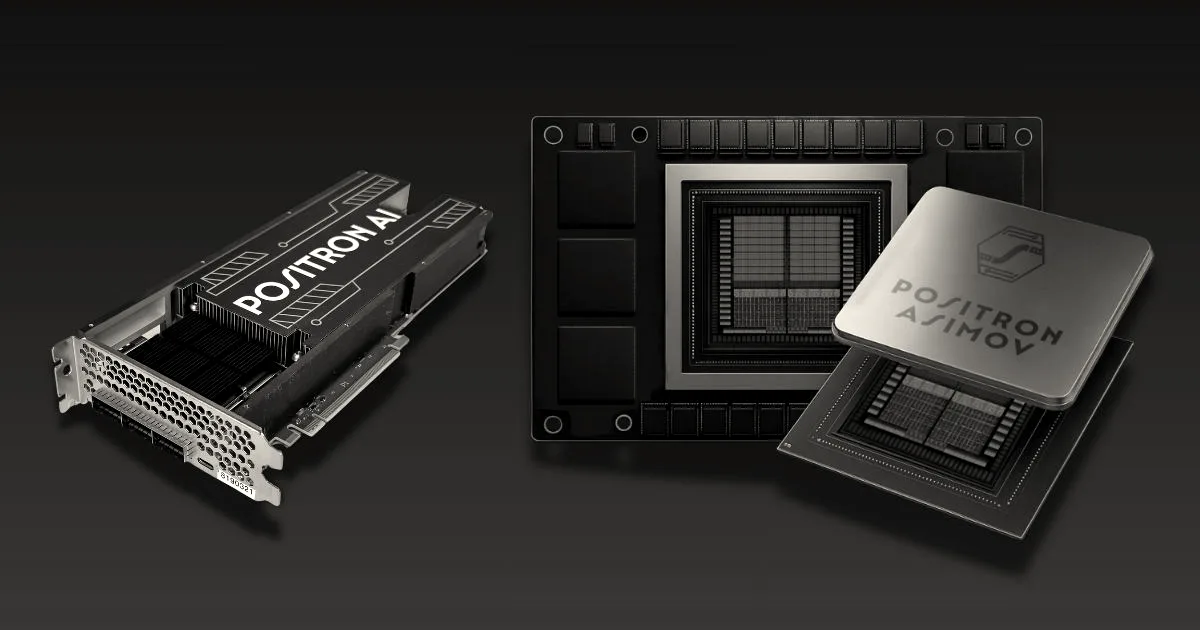
Reno-based semiconductor startup Positron has secured $230 million in Series B funding, reaching a $1 billion valuation. The investment round was co-led by a group of financial firms and backed by Qatar’s sovereign wealth fund:
- Arena Private Wealth (co-lead)
- Jump Trading (co-lead)
- Unless (co-lead)
- Qatar Investment Authority (strategic investor)
The funding round comes as large-scale cloud computing providers and artificial intelligence developers seek to reduce their reliance on market leader Nvidia. Among these companies is OpenAI, which is reportedly unsatisfied with some of the firm’s latest AI chips and has been seeking alternatives.
For Qatar, the investment through its sovereign wealth fund, the Qatar Investment Authority, aligns with a broader national strategy to build sovereign AI infrastructure—computing capacity owned or controlled by a nation-state. This priority was highlighted this week at the Web Summit Qatar in Doha. Qatari officials view domestic computing capacity as vital for maintaining competitiveness on the global economic stage. This strategy is supported by other major initiatives, including a $20 billion AI infrastructure joint venture with Brookfield Asset Management that was announced in December.
Positron plans to use the new capital to accelerate its product roadmap. The startup has raised just over $300 million in total capital, which includes $75 million raised last year from previous investors. Its previous backing came from investors including Valor Equity Partners, Atreides Management, DFJ Growth, Flume Ventures, and Resilience Reserve. Positron claims its first-generation chip, Atlas, can match the performance of Nvidia’s H100 GPUs for less than a third of the power. The startup focuses specifically on inference—the computing needed to run AI models for real-world applications—rather than training large language models. With the new funding, Positron aims to accelerate its roadmap to ship its next-generation Asimov silicon chip, targeting production in early 2027. Sources also report that Positron’s chips perform strongly in high-frequency and video-processing workloads.
Why it matters
Positron’s funding highlights the growing effort by large-scale cloud computing providers to find alternatives to Nvidia’s chips. It also underscores Qatar’s strategic push to build sovereign AI infrastructure to remain competitive on the global economic stage.